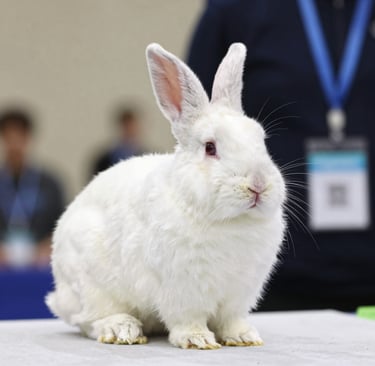
Bunnies can be very affectionate and a strong bond between rabbit and
owner can be established.  Below is some information on bonding with your
rabbit or bonding pairs of rabbits.

How Can I Bond With My Bunny Companion?

When they're happy and full of energy, they'll run around hopping. When
they're hungry, they'll beg for food or get cranky and start chewing on their
cage or throwing their food bowl around.  When they want attention, they'll
jump up or nudge at you until you stop what you're doing and pet them. And
if they think you're in the way, they'll let you know by nudging you with their
nose.  They may lightly nip at you if you don't move.  Try and discourage
nipping behavior.

Rabbits feel safe on the ground. So your rabbit may not want picked up and
held. Letting a rabbit sit next to you is their preference. Sitting on the floor,
ground, or furniture with them is an alternative to holding the bunny in the
Let him/her approach you and then pet of pick up your bunny.

Our rabbits like being stroked on their forehead and cheeks. They put their
head on the ground and close their eyes in contentment. They also love
getting a good back scratch around the shoulders. Rabbits are very curious
animals, so your bunny may just be distracted by all the potential things
around them to explore.

Bunnies have individual personalities. With time and patience, you will learn
what makes your rabbit happy. Then your bunny will come to trust and love
you. If your bunny lives in a cage, it's a good idea to plan exercise and play
time.  Bunnies love to play. As you discover your rabbit's unique personality
you will come to find the type of games he/she likes to play.


Handling Your Pet Rabbit:

Never pick up a rabbit by the ears.  It is painful and can cause serious
damage.  Rabbits are fragile. They have weak skeletal systems.  Dropping
a rabbit can cause a spinal or leg injury. To pick up your bunny, pick
him/her up by placing a hand under it's body and pull your bunny close to
you. Support the rabbit's hindquarters. Your bunny needs to feel secure in
your arms.  If your rabbit struggles when being picked up, hold him/her
firmly, but be ready to put him/her down. Your rabbit may think the better
alternative to being held is to leap from your arms, but this can cause
serious injury.  When putting your rabbit down, slowly squat down while
holding your bunny close, and let him/her down gently  Teach your bunny to
be held in the opposite direction with it's back to you and holding it secure
to your chest for
nail trimming.  Holding the bunny on it's back and stroking
the cheeks is very relaxing to your bunny.  Doing this will calm your bunny
down.  If your bunny is very frightened, cover the bunnies eyes. Practicing
holding your bunny in the
nail trimming position will help get him/her used to
being held in this way.
Bunny Trail  Farm
Rabbit Bonding
© Bunny Trail Farm 2005.  All Rights Reserved.
How Can I Bond My Rabbit With My Other Pets Or Rabbits?


Socialization With Other Animals:

Rabbits often get along well with de-clawed house cats, although care
should be used when introducing these natural adversaries. Some books
recommend keeping rabbits and guinea pigs together which we have done
however not all rabbits will share a cage with a guinea pig.  Dogs will get
along well with a house rabbit as long as the dog is not a breed or
personality of canine that chases small prey.  Birds pose no problems with
rabbits as long as the bird is not a large bird that tends to bite.  Introduce
your current house pets to your rabbit and allow them time to bond or at
least have mutual respect for one another's presence and territory.  
Rabbits may very well enjoy playing with other pets who they have bonded
with or are not afraid of.  Sometimes it is the predator such as a dog that
has the fear of the rabbit who is a prey animal.  Even if this is not natural for
rabbits to do, they will do it if they feel dominant over the dog or even a cat.
Rabbits will even hop over a dog or cat in an attempt to play with them.

Bunny Bonding Multiple Rabbits:

Single bunnies usually do well alone and bond quickly to their owners but if
two or more bunnies are desired, separate cages should be available by
the time they reach 3 months of age or younger. Bunnies generally prefer
their own private space as they mature, so cramped living quarters can
lead to disagreements and possible serious injuries, as one bunny is likely
to become dominant in deciding that the other bunny is invading their
space. Bucks seldom get along after reaching puberty and does usually
also tend to start disagreeing around that age. You already have a rabbit  
but, you wonder, is he/she lonely when you're not at home? If your bunny is
going to be alone for eight hours or more a day, you may want to consider
getting your bunny another rabbit friend.

It's a simple fact that some rabbits have the perfect personality for bonding
with another rabbit, and some bunnies just have to be single buns. A single
bunny, who is spoiled and lavished with love and attention, can be just as
happy as a bunny who is bonded with another bunny (who are both spoiled
and lavished with attention by their devoted bunny owners).

It is a good idea that before you get your bunny a companion you have her
spayed or him neutered. Both rabbits should be altered, and it's best to wait
until two weeks after the operation to introduce your rabbit to a new friend.
This time period will allow your bunny to fully recover from her surgery. If
you have a male bunny, it will also give his body time to be rid of its
hormones. (For up to two weeks after neutering, males are able to
impregnate fertile females).  Or, you might want two bunnies right from the
start. Litter mates may make good rabbit companions.

We should also dispel some common myths. While it is true same sex pairs
generally don't tend to get along very well upon first meeting, that doesn't
mean it is impossible to bond two girls or two boys. It is possible if you have
patience and understanding of the bonding process. It's also possible to
bond a tiny dwarf bunny with a larger rabbit. The size is not the dominant
factor.

You shouldn't be surprised if one bunny mounts the other bunny. This is
more of a sign of dominance than anything else. It's the bunny saying, I
want to be top dog. Don't be surprised if your little girl mounts the boy she's
meeting; she's just setting some ground rules for what she expects from him.

If the boy mounts the girl, and she doesn't react, that's a good sign that the
bonding should go fairly smoothly. If she runs away when he tries to mount
her, don't worry. The way to know you're going to have to take time and
have patience with the bonding is if the girl turns around and tries to attack
or becomes in any way aggressive when the boy tries to mount her.

Another common reaction upon first introductions is to give chase. (One
bunny chases the other). This is perfectly fine, if the chased bunny doesn't
turn around and fight back. If the chased bunny does fight back, separate
the two bunnies and realize the bonding process is going to have to move
more slowly than you had hoped for.

In fact, don't be surprised if there are fights during the bonding process. It's
not the end. It just means you should be prepared to take things slow.
There's bound to be some scrapes between bunnies, and this is normal.
You can stop a fight by yelling no or making a loud noise.  It's important that
each bunny has a separate cage of his/her own.  Rabbits like their own
living space.  You can let the bunnies out in the open to play.  This reduces
fights over territory.  

If you have just one bunny, don't assume it is lonely.  Rabbits can live just
fine by themselves without another rabbit friend.